

We Speak Finance_
Talk to an expert

Chile's pension reform replaces the five multifunds with ten generational funds in April 2027. Using public data, we estimate how AFP demand for Chilean assets shifts: favorable and stable for local equities, and smaller and sensitive —it can flip sign— for local fixed income.
Chile's pension reform replaces the five multifunds with ten generational funds in April 2027. By reordering savings by age, the AFPs' demand for Chilean assets shifts across asset classes. The effect on local equities is favorable and stable; the effect on local fixed income is smaller and can flip sign depending on where each AFP positions itself within the regulatory range. These are model estimates based on public data, not official figures.
Estimated net AFP demand for Chilean assets, in trillions of pesos.
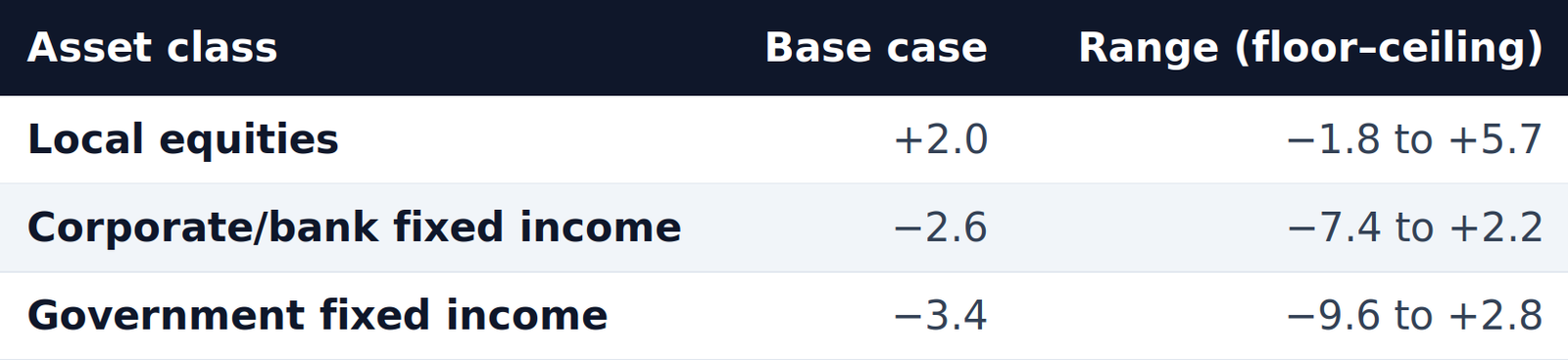
In the base case, local equities see net buying (~+2.0) and local fixed income sees contained net selling. The ranges reflect the sensitivity test: where each AFP can position itself within the regulatory range.
From five multifunds to ten funds by birth year.
The regime sets a range (floor–ceiling) by class and age. The sign of local fixed income changes within that range: local equities are robust —favorable across nearly the whole range, only slightly negative at the extreme floor— while local fixed income goes from heavy selling at the floor to buying at the ceiling. In other words, the sign of the effect on local debt is determined not by the reform itself, but by each administrator's strategic decision within the allowed range.
Voluntary savings and the reserve (encaje) —about one-fifth of the fund— can be attributed proportionally or concentrated in high balances. It's the assumption that moves local fixed income the most.

Figures in percentage points of total AUM. Local equities remain favorable in all three assumptions; local fixed income is the sensitive class.
Concentration is only stressed at the ceiling, and only in banks.
In the base case there are no forced sales. No issuer or corporate group meaningfully exceeds the per-fund limits. The migration even dilutes the concentration of today's multifunds.
At the ceiling, a bank cap. If the AFPs took local fixed income to the top of the range, the 4% per-bank limit breaks for two or three banks.
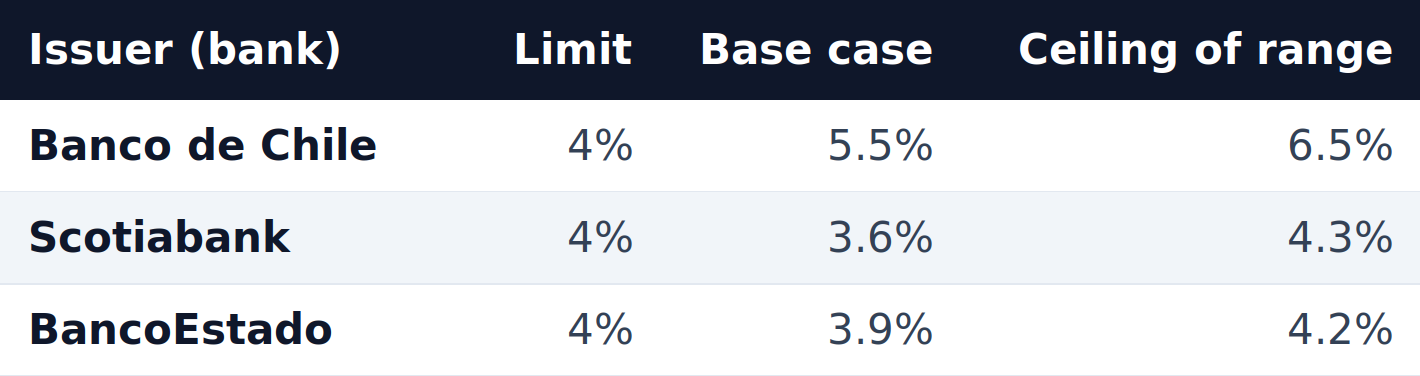
Corporates (3.5%) and groups (10%) keep headroom. The breaking point at the extreme is bank concentration: it would force substituting issuers, not switching asset class. The per-company limits (7% of equity, 12% of assets) are measured against each AFP's total —which doesn't change with the migration— and are not breached.
Method, in four steps:
AUM by age. Savings by age bracket are estimated using the SP's data on members by balance and age (Mar-2026), and regrouped into the ten generational funds.
Current portfolio. The SP's disaggregated portfolio (Feb-2026) is loaded at the issuer level, isolating the local market: domestic equities and government, bank, and corporate fixed income.
Migration. Each cohort carries its share of each fund's portfolio, yielding the initial portfolio of each generational fund. Totals are preserved.
Demand. Migrated holdings are compared with the regime's reference portfolio, measuring net buying/selling by class at the system level, with its sensitivity range.
Base-case assumptions:
Caveats:
Sources: Superintendencia de Pensiones (Pensions Supervisor) — Pension Funds' Investment Portfolio (Feb-2026); Members by balance in the individual capitalization account and age (Mar-2026). Regime: Exempt Resolution No. 910 (Jul 3, 2026), Investment Regime for Generational Funds, Law No. 21,735 (under public consultation).

Gonzalo Reyes
Founding Partner | Economist, U. de Chile
He has 13 years of experience in the financial industry. He served as an economist and senior strategist at Credicorp Capital, and is an expert in monetary policy, international finance, economic forecasting and asset allocation.